
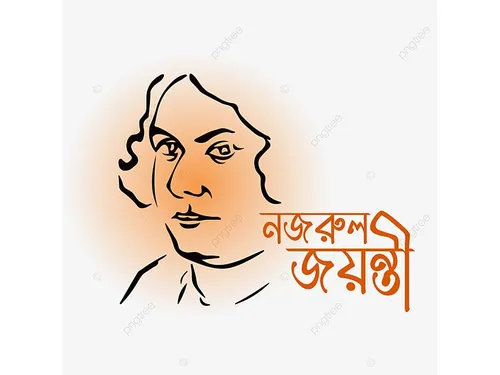
Kazi Nazrul Islam Jayanti, observed every year on May 25th, celebrates the birth of the Rebel Poet of Bengal. He is recognized as the national poet of Bangladesh and a towering figure in Bengali literature. Known as “Bidrohi Kobi,” Nazrul championed rebellion, equality, and humanism, leaving an enduring influence on South Asian culture and politics.
Nazrul was born on May 25, 1899, in Churulia, Burdwan district, West Bengal, India. He belonged to a modest Bengali Muslim family. His father, Kazi Faqeer Ahmed, worked as an imam and caretaker of the local mosque. From childhood, Nazrul absorbed religious teachings and cultural traditions that later shaped his literary vision. Although his early education focused on Islamic studies, Nazrul soon discovered a love for music and literature. Consequently, he joined local theatrical groups, where he refined his skills in poetry and performance. Through these experiences, he broadened his horizons and developed an appreciation for diverse artistic expressions.
In 1917, at only 18 years old, Nazrul enlisted in the British Indian Army. He served in the Middle East during World War I. Consequently, the brutal realities of war and colonial rule deeply affected his worldview. Even while serving, he continued writing poems and songs. His works reflected disillusionment with imperialism and a growing commitment to justice. These experiences awakened the fierce rebel spirit that later defined his career.
After leaving the army, Nazrul settled in Kolkata and fully devoted himself to literature. In 1922, he published his iconic poem Bidrohi (“The Rebel”). This fiery piece instantly made him famous and earned him the title “Rebel Poet.” Nazrul’s works extended beyond poetry. He wrote novels, essays, and songs infused with themes of freedom, equality, and spiritualism. Moreover, he composed nearly 4,000 songs, collectively called Nazrul Geeti. These ranged from patriotic anthems and devotional hymns to stirring romantic ballads.
Nazrul’s writings served not only as art but also as tools of political resistance. He fiercely criticized British colonial rule through his magazine Dhumketu (“The Comet”). Furthermore, he championed Hindu-Muslim unity, women’s rights, and social equality. Because of his outspoken activism, British authorities censored his works and imprisoned him. Yet, even in jail, he produced powerful writings like Rajbandir Jabanbandi (“The Deposition of a Political Prisoner”). These works reflected his unwavering fight for justice.
Tragically, in his later years, Nazrul suffered from a severe illness, believed to be Pick’s disease. This condition robbed him of his voice and ability to write. Nevertheless, his influence continued to grow. After Bangladesh gained independence in 1971, he was honored as the national poet. He moved to Dhaka, where he spent his final years until his death on August 29, 1976.
Nazrul Jayanti is celebrated with passion in Bangladesh and Indian states like West Bengal and Tripura. The day features poetry recitations, music programs, and cultural events dedicated to his memory. Moreover, educational institutions and cultural groups organize seminars to inspire younger generations with his life and works.
Kazi Nazrul Islam’s life symbolizes courage, creativity, and resistance against oppression. His works continue to inspire movements for justice and harmony. Through Nazrul Jayanti, people honor his legacy while remembering the power of art to transform society.