

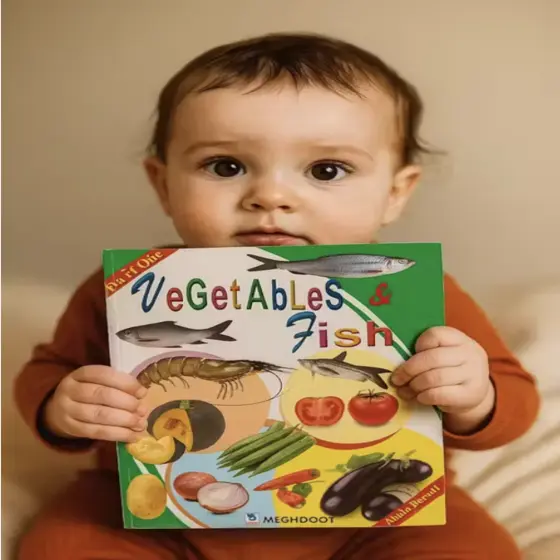
Bengali Learning Book – Vegetables and Fish | Learn Bengali Words for Kids
Make Bengali Vocabulary Learning Fun and Easy
Introduce your child to everyday Bengali words with the Bengali Learning Book – Vegetables and Fish, an educational book designed to help young learners become familiar with common vegetables and fish in Bengali. This beginner-friendly learning resource can make language learning more enjoyable by connecting new words with familiar foods found in everyday life.
Children learn best when they can relate new information to their surroundings. Therefore, learning the Bengali names of vegetables and fish can help them expand their vocabulary while developing a stronger connection with their mother tongue. Whether your child is beginning to learn Bengali at home or practising alongside school lessons, this book can make the learning process more engaging and meaningful.
Learn Bengali Vegetable Names Through Everyday Objects
Vegetables are an important part of everyday life, making them a useful starting point for children’s vocabulary development. By learning their Bengali names, children can gradually become more confident in recognizing familiar foods and using the correct words in daily conversations.
For example, parents can introduce common vegetables such as আলু (potato), বেগুন (brinjal), টমেটো (tomato), গাজর (carrot), and ফুলকপি (cauliflower). Furthermore, pointing to these vegetables while saying their Bengali names helps children connect spoken words with real objects.
Regular practice can also encourage children to ask questions, identify different vegetables, and remember new vocabulary naturally.
Discover the Names of Fish in Bengali
Fish holds a special place in Bengali food culture, making fish-related vocabulary particularly meaningful for young learners. Learning the Bengali names of familiar fish can help children understand everyday conversations about food, shopping, and family meals.
Parents can introduce common fish names such as রুই (Rohu), কাতলা (Catla), ইলিশ (Hilsa), and মাগুর (Magur). In addition, discussing familiar fish found in local markets can make vocabulary practice more interactive.
Children can repeat the names aloud, identify fish in pictures, and connect each word with their everyday experiences. As a result, they can gradually build vocabulary while developing a deeper familiarity with Bengali language and culture.
Why Choose a Bengali Learning Book About Vegetables and Fish?- Build Bengali vocabulary: Introduces children to common vegetable and fish names.
- Encourage language development: Helps young learners practise familiar words and expressions.
- Support visual learning: Pictures, where included in the edition, can help children connect words with objects.
- Improve word recognition: Repetition helps children remember and identify new vocabulary.
- Connect learning with daily life: Makes it easier to practise Bengali during shopping, cooking, and family conversations.
- Preserve mother-tongue familiarity: Encourages children to use Bengali in everyday situations.
A Useful Learning Resource for Home and School
The Bengali Learning Book – Vegetables and Fish can be a helpful addition to early language-learning activities. Parents can use it during short reading sessions, while teachers can introduce food-related vocabulary through classroom exercises.
For instance, ask your child to name a vegetable in Bengali, identify a fish from a picture, or repeat a word after you. Moreover, turning these activities into simple games can make learning more enjoyable and encourage children to participate actively.
For Bengali-speaking families living outside West Bengal, the book can also help children remain familiar with the language and food traditions of Bengal.
A Thoughtful Educational Gift for Young Learners
Looking for a practical educational book for a young child? This Bengali vocabulary book can be a useful choice for birthdays, preschool learning, home education, or a child’s first collection of language-learning resources.
By introducing familiar vegetables and fish, it offers an opportunity to combine language practice with everyday discovery. Most importantly, parents can help children develop a positive attitude towards learning by making each new word an enjoyable discovery.
Frequently Asked Questions (FAQ)1. What is the Bengali Learning Book – Vegetables and Fish?
It is a Bengali vocabulary learning book intended to introduce children to the names of common vegetables and fish, helping them develop everyday language skills.
2. Who can use this Bengali learning book?
It may be suitable for preschool children, early learners, and beginners who are developing their Bengali vocabulary. The appropriate age group depends on the specific edition.
3. How can children learn vegetable names in Bengali?
Children can practise by reading the names, looking at pictures where available, and identifying real vegetables at home or in the market.
4. Why should children learn fish names in Bengali?
Learning fish names helps children expand their vocabulary and understand words they may hear during family meals, shopping, and everyday conversations.
5. Can parents use this book for home learning?
Yes. Parents can introduce a few words each day, encourage children to repeat them, and make learning interactive through simple identification games.
6. How does learning Bengali vocabulary benefit children?
Building vocabulary helps children recognize words, communicate more confidently, and develop a stronger foundation for reading and speaking Bengali.
Start Your Child’s Bengali Vocabulary Journey
Make everyday learning more exciting with the Bengali Learning Book – Vegetables and Fish. By introducing familiar foods and their Bengali names, this educational resource can help young learners build vocabulary, practise their mother tongue, and discover the joy of learning through everyday experiences.



Reviews
There are no reviews yet.