

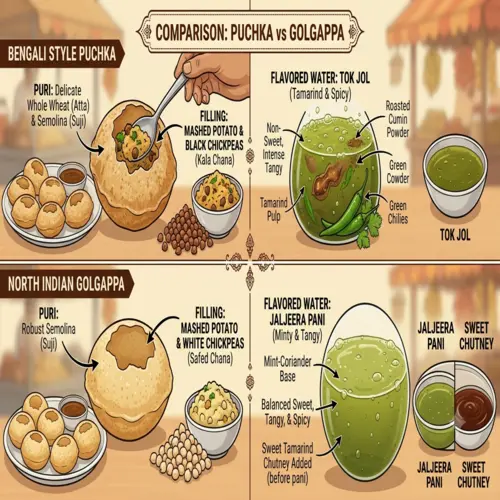
If you love Indian street food, you have probably tasted or at least heard of puchka, golgappa, pani puri, or gupchup. At first glance, they may look almost identical. Each one features a crisp, hollow puri filled with a delicious mixture and served with flavoured water. However, once you take a bite, you quickly notice that each regional version has its own personality.
Among these varieties, Bengali-style puchka stands out for its distinctive filling, tangy flavour, and spicy mashed potato mixture. In contrast, golgappa, particularly the North Indian version, often uses a different filling and flavoured water. So, what exactly makes Bengali puchka different from golgappa?
Let us explore the delicious differences between these popular Indian street foods.
What Is Bengali Puchka?
Puchka is one of the most beloved street foods in Bengal. You will find puchka stalls in Kolkata, Howrah, Siliguri, Durgapur, and many other parts of West Bengal.
The classic Bengali puchka uses a crisp, hollow puri filled with a mixture of boiled potatoes, spices, green chilli, black salt, and often roasted cumin. The vendor then adds tetul jol, or tamarind water, to create its characteristic sour and spicy taste.
Unlike some other versions of pani puri, Bengali puchka often has a stronger tamarind flavour. The filling also plays a major role in the overall taste.
For many Bengalis, puchka is more than a snack. It is an important part of everyday street-food culture and a favourite treat enjoyed with friends and family.
What Is Golgappa?
Golgappa is a popular name for this type of street food in several parts of North India. It is especially associated with regions such as Delhi, Punjab, Haryana, Uttar Pradesh, and Rajasthan.
Like puchka, golgappa consists of crisp, hollow puris filled with a mixture and flavoured water. However, the exact ingredients can vary considerably from one region to another.
The filling may include potatoes, chickpeas, boondi, spices, and other ingredients. The water can also range from spicy mint water to sweet and tangy tamarind water.
Therefore, there is no single recipe for golgappa. Regional preferences strongly influence its taste and preparation.
Bengali Puchka vs Golgappa: The Main Differences
Although both snacks share the same basic concept, several important differences make them unique.
1. The Potato Filling
The filling is one of the biggest differences.
Bengali puchka traditionally uses a strongly flavoured mashed potato filling. Cooks mix the potatoes with green chilli, black salt, roasted spices, and other seasonings.
Golgappa, on the other hand, may use potatoes along with chickpeas, boondi, peas, or other ingredients depending on the region.
As a result, Bengali puchka often tastes more intensely spicy and tangy from the filling itself.
2. The Flavoured Water
Bengali puchka is famous for its tetul jol. Vendors prepare the water using tamarind pulp, spices, salt, chilli, and other ingredients.
The result is usually distinctly sour, spicy, and refreshing.
Golgappa water varies more widely. Some versions use mint, coriander, green chilli, black salt, and spices, while others combine spicy water with sweet tamarind water.
Therefore, the flavour of Bengali puchka often feels more tamarind-forward, whereas golgappa can offer a broader range of sweet, spicy, minty, and tangy flavours.
3. The Puri
The puri used for puchka and golgappa looks similar, but small differences can occur in size, texture, and preparation.
Bengali puchka puris are often slightly darker and more robust than some North Indian pani puri shells. Their crisp texture makes them ideal for holding the generous potato filling and tangy tamarind water.
Golgappa puris can vary depending on the vendor and region. Some are very thin and delicate, while others have a slightly thicker crunch.
Ultimately, freshness matters more than appearance. A good puchka or golgappa should have a crisp shell that breaks immediately when you bite into it.
4. The Overall Flavour
The overall flavour profile provides perhaps the clearest distinction.
Bengali puchka:
Spicy, tangy, sour, earthy, and strongly influenced by tamarind and seasoned potato.
Golgappa:
Spicy, tangy, refreshing, and sometimes sweet, with flavours that vary depending on the regional recipe.
Consequently, someone accustomed to Kolkata puchka may find North Indian golgappa noticeably different, even though both snacks look almost identical.
Puchka, Golgappa and Pani Puri: Are They the Same?
People often use the names puchka, golgappa, and pani puri interchangeably. However, regional food traditions have created distinct versions of the same basic street-food concept.
In West Bengal, people commonly say puchka. In many parts of North India, golgappa is the preferred name. In Maharashtra, Gujarat, and several other regions, pani puri is widely used.
There are also regional variations such as gupchup in parts of eastern and central India.
Although the names differ, the basic idea remains similar: crispy puris, a flavourful filling, and spiced water come together to create an exciting street-food experience.
Why Puchka Is So Important in Bengali Culture
Puchka has become deeply connected with Bengali social life, especially among younger generations.
In Kolkata, a puchka stall can become a meeting point for friends, students, families, and couples. People often stand around the stall, chatting while the vendor prepares one puchka after another.
Moreover, puchka is affordable, accessible, and highly customisable. You can ask for extra chilli, more tamarind water, less salt, or additional filling according to your taste.
The experience itself is part of the attraction. The vendor quickly cracks open each puri, adds the filling, dips it into the tamarind water, and hands it directly to you. You eat it immediately, usually in one bite.
The Bengali Puchka Experience
Eating puchka in Bengal is not simply about the ingredients. It is about the entire experience.
You stand beside a busy roadside stall and watch the vendor prepare each serving. The smell of tamarind, roasted spices, and fresh green chilli fills the air. Friends compete to see who can eat the most, while everyone debates whether the next puchka should have more chilli or extra tetul jol.
That combination of flavour, freshness, conversation, and nostalgia makes puchka special.
Conclusion
Bengali puchka and golgappa may look similar, but their flavours tell different regional stories. Bengali puchka stands out with its seasoned potato filling, strong tamarind water, spicy flavour, and distinctive Kolkata street-food culture.
Golgappa, meanwhile, offers its own delicious variations across North India, with different fillings and flavoured waters.
Ultimately, there is no need to choose one over the other. Both celebrate India’s incredible street-food diversity. However, if you want to experience a true taste of Bengali street food, a freshly prepared plate of Kolkata-style puchka with spicy potato filling and tangy tetul jol is an experience you should not miss.