
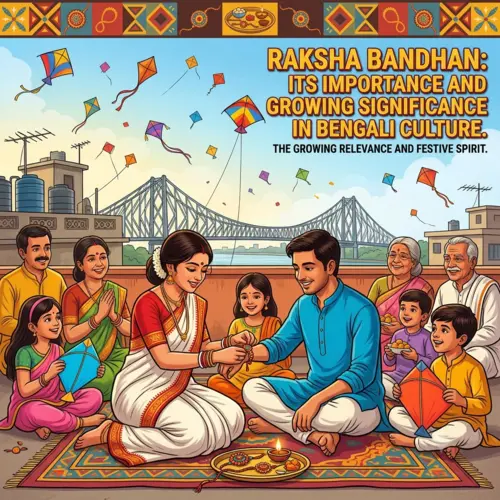
Raksha Bandhan is one of India’s most cherished festivals, celebrating the special bond of love, care, trust, and protection between brothers and sisters. On this auspicious day, sisters tie a sacred thread, known as a Rakhi, around their brothers’ wrists. In return, brothers traditionally promise to support and protect their sisters and often give them gifts as a symbol of affection.
Although Raksha Bandhan has historically been more prominent in many parts of North and Western India, the festival has also gained significant recognition in Bengal. Today, Bengali families celebrate Rakhi with great warmth, while the festival has also developed a broader cultural meaning based on friendship, unity, and social harmony.
The Meaning and Significance of Raksha Bandhan
The words Raksha Bandhan carry a powerful meaning. “Raksha” means protection, while “Bandhan” means bond. Therefore, Raksha Bandhan represents a sacred bond of love and responsibility.
Traditionally, a sister ties the Rakhi on her brother’s wrist, applies a tilak, performs an aarti, and offers sweets. The brother then gives a gift and promises to stand beside his sister during difficult times.
However, the meaning of Raksha Bandhan has evolved over time. Today, many people celebrate the festival with cousins, friends, and even individuals who share a strong emotional connection. As a result, Rakhi has become a symbol of mutual respect and support rather than simply a ritual between biological brothers and sisters.
Raksha Bandhan and Bengali Culture
Bengal has a rich tradition of celebrating festivals that strengthen family relationships and social unity. Therefore, although Raksha Bandhan does not hold the same historical position in Bengali culture as Durga Puja, Kali Puja, Poila Boishakh, or Bhai Phonta, it has gradually become a familiar and joyful celebration in many Bengali households.
Modern Bengali families often celebrate Raksha Bandhan by bringing brothers and sisters together. Children especially enjoy choosing colourful Rakhis, decorating their homes, sharing sweets, and exchanging gifts.
Moreover, television, films, schools, workplaces, and social media have helped popularise the festival across Bengal. Consequently, Raksha Bandhan has become an occasion that many Bengali families look forward to each year.
The Special Connection Between Raksha Bandhan and Bengal
Raksha Bandhan also has a unique historical and cultural connection with Bengal through the idea of unity. During the anti-partition movement in Bengal in 1905, Rabindranath Tagore encouraged people to observe Raksha Bandhan as a symbol of harmony and brotherhood.
Instead of limiting the sacred thread to family relationships, Tagore promoted the tying of Rakhi among people from different communities. His message focused on unity and mutual respect. Therefore, the Rakhi became a powerful symbol of social bonding and communal harmony in Bengal.
This historical association gives Raksha Bandhan a special place in Bengali cultural memory. Even today, the festival can remind people that society becomes stronger when individuals respect, support, and protect one another.
Traditional Raksha Bandhan Celebrations
On Raksha Bandhan, families often begin the day by preparing for the ceremony. Sisters select beautiful Rakhis and arrange a thali containing traditional items such as rice, sandalwood paste, sweets, and a lamp.
During the ceremony, the sister ties the Rakhi around her brother’s wrist and wishes for his happiness, health, and success. The brother then expresses his affection and offers a gift.
Afterward, families enjoy sweets and special meals together. Popular Indian sweets such as rosogolla, sandesh, mishti doi, and laddoo often add extra sweetness to the celebration in Bengali households.
Furthermore, families frequently capture photographs and share their celebrations with relatives and friends. In the digital age, people also send Rakhi wishes and messages to loved ones who live far away.
Raksha Bandhan in Modern Bengali Society
Today, Raksha Bandhan continues to evolve. The festival now celebrates relationships based on affection and trust, regardless of traditional boundaries.
For example, sisters may tie Rakhis to cousins, close friends, or people they consider family. Similarly, some celebrations emphasise the idea of mutual protection, where both individuals promise to care for and support each other.
This changing interpretation makes Raksha Bandhan especially meaningful for modern Bengali society. While people continue to respect traditional customs, they also adapt the festival to reflect contemporary values such as equality, friendship, and mutual responsibility.
Why Raksha Bandhan Remains Important
Raksha Bandhan reminds people to value relationships in a busy world. Modern life often keeps families occupied with work, education, and daily responsibilities. Therefore, festivals such as Rakhi provide an opportunity for families to pause and reconnect.
The festival also teaches important values to children. It encourages love, responsibility, gratitude, and respect for family relationships. Moreover, the tradition of exchanging sweets and gifts creates happy memories that often remain with people for years.
In Bengali culture, where family bonds and emotional connections hold great importance, Raksha Bandhan naturally finds a meaningful place. It complements other Bengali traditions that celebrate siblings, family, and togetherness.
Conclusion
Raksha Bandhan is a beautiful celebration of love, trust, and lifelong support. While its traditions may differ across regions, its central message remains universal.
In Bengal, the festival has gained popularity while also carrying a deeper historical connection with unity and harmony. From the simple act of tying a colourful Rakhi to the larger message of standing beside one another, Raksha Bandhan continues to bring families and communities closer.
Ultimately, Raksha Bandhan reminds us that the strongest protection often comes from love, trust, and the promise to support those who matter most. In this way, the festival continues to enrich the colourful and diverse cultural landscape of Bengal.