

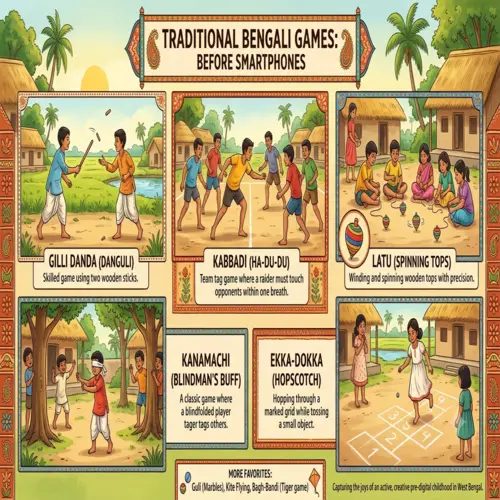
Before smartphones, tablets, video games, and social media became part of everyday life, childhood in Bengal looked very different. Children spent long afternoons in courtyards, school grounds, village fields, rooftops, and narrow neighbourhood lanes. Entertainment did not require an internet connection or a charging cable. Instead, imagination, energy, and a few friends were enough.
Traditional Bengali games brought children together and encouraged them to run, think, compete, and laugh. Many of these games required little or no equipment. A few stones, a ball, a piece of chalk, or simply an open space could provide hours of entertainment.
Today, these games bring back powerful memories for many Bengalis. More importantly, they remind us of a time when childhood meant outdoor play, friendship, and endless creativity.
1. Golli Danda: A Game of Skill and Timing
Golli Danda was popular in many parts of India, including Bengal. The game used two simple wooden sticks: a longer stick called the danda and a smaller pointed stick called the golli.
Players used the longer stick to strike the smaller one and send it flying. The game required good timing, hand-eye coordination, and quick reflexes.
Moreover, children could play Golli Danda almost anywhere with enough open space. They did not need expensive equipment, which made the game accessible to children from different backgrounds.
2. Danguli: Bengal’s Version of Gilli Danda
In Bengal, Danguli was a familiar traditional outdoor game. Children used a small piece of wood and a longer stick to hit it as far as possible.
The game created excitement because every player wanted to strike the danguli farther than everyone else. However, success depended on skill rather than expensive equipment.
Furthermore, Danguli encouraged children to spend time outdoors and develop coordination. Even today, the game remains an important memory of traditional Bengali childhood.
3. Kumir Danga: The Crocodile and the Island
Kumir Danga was one of the most exciting group games. One player became the kumir, or crocodile, while the others tried to move between safe areas without getting caught.
Players usually treated a particular space as land or an island, while the open area became the crocodile’s territory.
The game required speed, alertness, and strategy. Moreover, it encouraged children to cooperate, compete, and constantly stay active.
For many Bengali children, the shout of “Kumir!” was enough to start a chaotic and joyful race.
4. Chorkutkut: A Game of Strategy
Chorkutkut was a popular traditional game that involved teams, running, and strategy. The rules could vary from one neighbourhood to another, but the game generally required players to protect their team while attempting to catch or challenge opponents.
Children often created their own local rules. Consequently, the same game could look slightly different in different parts of Bengal.
However, this flexibility was part of its charm. Chorkutkut encouraged teamwork, quick thinking, and physical activity.
5. Kanamachi: The Classic Blindfold Game
Almost every Bengali child knows Kanamachi. One player closes or covers their eyes while trying to catch the other players.
The remaining players move around, tease the seeker, and try to avoid being caught. Once someone gets caught, they may become the next seeker.
The game required no equipment at all. Therefore, children could play it at home, in school, or during family gatherings.
Moreover, Kanamachi encouraged laughter and interaction. A simple blindfold could entertain a group of children for hours.
6. Bou Basanti: A Game of Imagination
Traditional Bengali childhood also included games based on imagination and role-playing. Bou Basanti, or playing house, allowed children to create miniature families and households.
Children assigned roles such as mother, father, child, shopkeeper, teacher, or cook. They used leaves, mud, flowers, and small containers as imaginary food and household items.
Furthermore, this type of play encouraged creativity and storytelling. Children learned by observing the world around them and then recreating it through their own imagination.
7. Ekka Dokka: The Bengali Hopscotch
Ekka Dokka was a favourite game among children, especially in school playgrounds and neighbourhood courtyards.
Players drew numbered boxes on the ground using chalk or a piece of stone. They then threw a small object into one of the boxes and hopped through the pattern without stepping on the wrong lines.
The game required balance, concentration, and coordination. Moreover, children could easily organise a game almost anywhere.
Even today, seeing an Ekka Dokka pattern drawn on the ground can immediately bring back memories of childhood.
8. Latim: The Spinning Top Game
The Latim, or spinning top, was once a prized possession for many children. Players wrapped a string around the top and pulled it sharply to make it spin.
Children competed to see whose Latim could spin for the longest time. Some skilled players could even perform tricks while the top continued spinning.
Furthermore, children often decorated their Latims or proudly showed off their spinning skills to friends.
The game taught patience and coordination because learning to spin the top successfully required practice.
9. Marble Games
Playing with guli, or marbles, was another popular childhood activity. Children collected colourful glass marbles and competed with friends using different local rules.
Some players became highly skilled at aiming and striking other marbles. Winning often meant adding the opponent’s marbles to your own collection.
Therefore, a small bag of marbles could become a treasured childhood possession. The game also encouraged concentration, planning, and friendly competition.
10. Ludo and Carrom: The Indoor Classics
Although children could not always play outside, traditional indoor games provided plenty of entertainment.
Ludo brought families and friends together around a board, while Carrom tested accuracy and strategy. Children often spent rainy afternoons competing with siblings, cousins, and neighbours.
Moreover, these games encouraged face-to-face interaction. Players celebrated victories, argued about rules, and laughed together—experiences that are difficult to recreate through solitary screen time.
Why Traditional Bengali Games Still Matter
Traditional games offered more than entertainment. They encouraged children to stay physically active, develop social skills, and use their imagination.
Unlike many digital games, these activities required direct interaction. Children learned how to cooperate, compete fairly, solve small disagreements, and make friends.
Furthermore, most traditional games required very little money. This made them accessible to children across villages, towns, and cities.
Today, parents and schools can reintroduce these games during cultural programmes, sports activities, and family gatherings. Even a few hours of Kanamachi, Ekka Dokka, or Latim can give children a refreshing break from screens.
Conclusion
The traditional games we played before smartphones represent a colourful chapter of Bengali childhood. From the excitement of Danguli and Kumir Danga to the laughter of Kanamachi and the concentration required for Latim and marbles, these games created memories that many people still cherish.
Of course, technology has changed childhood. However, traditional games still have something valuable to offer.
They remind us that fun does not always require a screen. Sometimes, all we need is an open space, a simple game, a few friends, and the freedom to play.
By introducing these traditional Bengali games to new generations, we can preserve childhood memories while creating new ones for the future.