

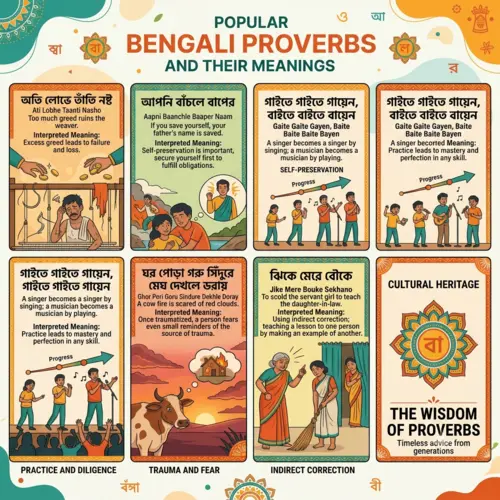
Popular Bengali Proverbs and Their Meanings
Bengali is a language rich in literature, poetry, humour, and wisdom. Beyond famous poems and stories, everyday Bengali conversations are also filled with colourful proverbs, known as probad or probad-bakya. These short expressions often carry deep meanings and offer practical lessons about life, relationships, work, and human behaviour.
For generations, grandparents, parents, teachers, and elders have used Bengali proverbs to explain complicated ideas in a simple and memorable way. Moreover, these sayings often use familiar images from village life, animals, food, nature, and everyday experiences.
Although modern Bengali conversations increasingly include English words and digital expressions, traditional proverbs still remain an important part of the language. Here are some popular Bengali proverbs and their meanings.
1. অতি লোভে তাতি নষ্ট
Ati lobhe tanti noshto
Meaning: Excessive greed can lead to loss.
This popular proverb teaches us that greed often brings negative consequences. A person may already have enough, but the desire for more can encourage them to take unnecessary risks.
Therefore, the proverb reminds us to remain satisfied and make decisions wisely rather than allowing greed to control our actions.
2. অতি ভক্তি চোরের লক্ষণ
Ati bhakti chor-er lokkhon
Meaning: Excessive flattery may hide dishonest intentions.
People sometimes behave overly polite or flattering when they want something in return. Therefore, this proverb advises us to remain careful and not blindly trust every display of affection or respect.
However, it does not mean that every polite person has bad intentions. Instead, it encourages us to use good judgment.
3. যেমন কর্ম তেমন ফল
Jemon kormo temon fol
Meaning: As you sow, so shall you reap.
This proverb expresses the idea that our actions often shape the results we receive. Good actions can bring positive outcomes, while harmful actions may create negative consequences.
Consequently, it encourages people to act responsibly and consider the results of their choices.
4. নাচতে না জানলে উঠান বাঁকা
Nachte na janle uthhan baka
Meaning: A poor workman blames their tools.
This humorous proverb describes someone who blames external circumstances instead of accepting their own mistakes or limitations.
For example, if someone cannot perform a task properly but blames the environment, equipment, or other people, this proverb may apply.
Therefore, it teaches us to accept responsibility and improve ourselves rather than constantly finding excuses.
5. যার লাঠি তার মাটি
Jar lathi tar mati
Meaning: Might often controls possession or power.
This proverb reflects the reality that powerful people can sometimes dominate weaker individuals. Traditionally, it referred to land and physical power.
However, in modern life, people may use it to describe situations where influence or authority determines who gets control.
6. অল্প বিদ্যা ভয়ংকরী
Alpo bidya bhoyonkori
Meaning: A little knowledge can be dangerous.
When someone knows only a small amount about a subject but behaves as if they understand everything, mistakes can happen.
Therefore, this proverb encourages humility and reminds us to continue learning before making confident judgments.
7. এক হাতে তালি বাজে না
Ek hate tali baje na
Meaning: It takes two to create a conflict or situation.
A clap cannot happen with only one hand. Similarly, some disagreements or conflicts involve actions from more than one side.
However, this proverb should not be used to automatically blame both sides in every situation. Instead, its traditional meaning highlights the importance of understanding the role of everyone involved.
8. চোর পালালে বুদ্ধি বাড়ে
Chor palale buddhi bare
Meaning: Wisdom often comes after the opportunity has passed.
People sometimes realise what they should have done only after a problem has already occurred.
For example, someone may improve security only after a theft. Therefore, this proverb reminds us to think ahead and take precautions before problems arise.
9. গাছে কাঁঠাল গোঁফে তেল
Gachhe kathal gofey tel
Meaning: Counting your gains before achieving them.
The proverb describes someone who prepares to enjoy success before success has actually arrived.
For instance, imagining how you will spend money before earning it would fit this expression. Therefore, it teaches us to remain realistic and avoid celebrating too early.
10. নিজের নাক কেটে পরের যাত্রা ভঙ্গ
Nijer nak kete porer jatra bhongo
Meaning: Hurting yourself simply to harm someone else.
This proverb describes revenge that causes damage to both sides, especially the person seeking revenge.
Therefore, it reminds us that anger and jealousy can sometimes lead people to make decisions that hurt themselves more than others.
11. দাঁত থাকতে দাঁতের মর্যাদা বোঝে না
Dat thakte dater morjada bojhe na
Meaning: People often fail to value something until they lose it.
This proverb uses teeth as a simple example. People may not appreciate healthy teeth until they begin having dental problems.
More broadly, it teaches us to value our relationships, health, opportunities, and possessions while we still have them.
12. কানা ছেলের নাম পদ্মলোচন
Kana cheler naam Podmolochon
Meaning: Giving an impressive name to someone or something that does not match reality.
This proverb often adds humour to a situation where appearances and names do not match the truth.
However, people should use such expressions carefully because traditional sayings can sometimes contain language that feels insensitive in modern contexts.
13. শাক দিয়ে মাছ ঢাকা
Shaak diye machh dhaka
Meaning: Trying unsuccessfully to hide a major problem with a small excuse.
The expression suggests that something obvious cannot be hidden with an inadequate cover.
Therefore, people use it when someone attempts to conceal a serious issue using an unconvincing explanation.
14. অতি চালাকের গলায় দড়ি
Ati chalaker golay dori
Meaning: Over-smartness can eventually lead to trouble.
Someone who constantly tries to outsmart others may eventually create problems for themselves.
Consequently, the proverb encourages honesty and reminds us that excessive cleverness can sometimes backfire.
15. এক মাঘে শীত যায় না
Ek Maghe sheet jay na
Meaning: One setback does not mean everything is over.
This proverb offers encouragement during difficult times. A single failure, disappointment, or bad experience should not make us lose hope.
Therefore, it reminds us to remain patient and continue trying because circumstances can change.
Why Bengali Proverbs Still Matter
Bengali proverbs continue to remain relevant because they communicate complex ideas in just a few words. They combine wisdom with humour, making them easy to remember and share.
Moreover, these sayings connect modern Bengalis with the language and experiences of earlier generations. A proverb spoken by a grandparent may continue to appear in a family conversation decades later.
In addition, proverbs make everyday conversations more expressive. Instead of giving a long explanation, a familiar saying can immediately communicate an idea.
Conclusion
Popular Bengali proverbs are small pieces of cultural wisdom passed from one generation to another. They teach lessons about greed, responsibility, patience, relationships, knowledge, and human behaviour.
From “অতি লোভে তাতি নষ্ট” to “এক মাঘে শীত যায় না,” these expressions continue to add colour and meaning to the Bengali language.
Therefore, preserving and using Bengali proverbs is a wonderful way to keep the language alive. They remind us that sometimes a few simple words can carry the wisdom of generations.