

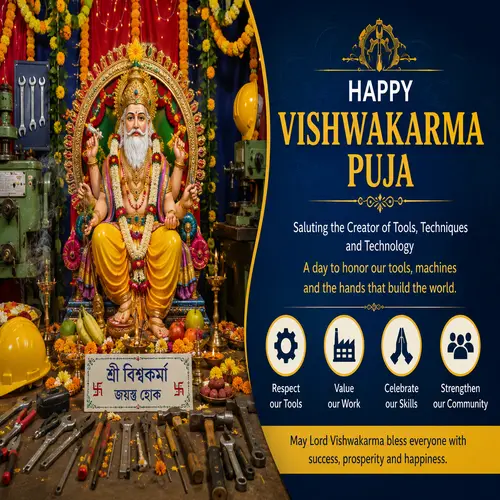
Vishwakarma Puja and Bengali Culture: Traditions, Rituals and the Spirit of Bengal
Vishwakarma Puja holds a special place in the cultural and religious calendar of Bengal. Every year, workplaces, factories, workshops, garages, engineering units, construction sites, and even homes across West Bengal celebrate the occasion with devotion and enthusiasm. The festival honours Lord Vishwakarma, the divine architect and craftsman, who represents creativity, engineering, craftsmanship, construction, and technical skill.
In Bengal, however, Vishwakarma Puja means more than simply worshipping machines and tools. The festival brings together workers, business owners, craftsmen, mechanics, engineers, artists, and families. Moreover, it creates a unique festive atmosphere filled with colourful decorations, traditional rituals, music, food, and community celebrations.
For generations, Bengali communities have preserved Vishwakarma Puja as an important part of their cultural heritage. The festival also reflects Bengal’s long-standing connection with craftsmanship, industry, transport, trade, and creativity.
Who Is Lord Vishwakarma?
According to Hindu tradition, Lord Vishwakarma is regarded as the divine architect and craftsman. Hindu mythology associates him with the creation of magnificent celestial structures, weapons, palaces, and divine objects.
As a result, artisans, engineers, mechanics, builders, architects, craftsmen, and people who work with tools traditionally regard Vishwakarma as their patron deity.
His image often shows him holding traditional tools associated with craftsmanship and construction. Therefore, Vishwakarma Puja celebrates both divine creativity and human skill.
The festival reminds people that every profession involving knowledge, precision, creativity, and craftsmanship deserves respect.
Vishwakarma Puja in Bengal
Vishwakarma Puja has developed a distinctive identity in Bengal. The festival is especially popular in Kolkata and industrial areas across West Bengal.
Factories and workshops begin preparing for the celebration several days in advance. Workers clean machines, tools, vehicles, and workspaces. Afterwards, they decorate the area with flowers, colourful paper decorations, banana leaves, lights, and traditional Bengali festive elements.
On the day of the puja, workers and owners gather together to offer prayers to Lord Vishwakarma. They place tools, machinery, equipment, vehicles, and other work-related objects before the deity.
Consequently, the workplace temporarily transforms into a festive space where professional life and religious tradition come together.
Why Do Bengalis Celebrate Vishwakarma Puja?
Bengali culture has always valued knowledge, skill, creativity, and craftsmanship. From traditional artisans to modern engineers, people across Bengal have contributed to the region’s rich cultural and industrial heritage.
Vishwakarma Puja provides an opportunity to express gratitude for these skills. Workers honour the tools that help them earn their livelihood, while business owners pray for prosperity, safety, productivity, and success.
Furthermore, the festival encourages people to respect labour. A machine may perform a task, but skilled workers operate, maintain, design, repair, and improve that machine.
Therefore, Vishwakarma Puja symbolically honours both the tools and the people behind them.
Vishwakarma Puja and Bengali Work Culture
One of the most interesting aspects of Vishwakarma Puja in Bengal is its connection with workplace culture.
Factories, printing presses, garages, engineering workshops, transport companies, construction businesses, and small workshops often organize collective celebrations. Employees participate in the puja together, regardless of their position within the organization.
This shared celebration creates a sense of community. Workers decorate their workplaces, arrange the puja, distribute prasad, and spend time together.
In many workplaces, the festival also becomes an occasion for employees to relax and celebrate after months of hard work.
As a result, Vishwakarma Puja strengthens relationships between workers and employers while preserving an important Bengali tradition.
The Famous Kite-Flying Tradition
Kite flying has become one of the most recognizable cultural associations of Vishwakarma Puja in Bengal.
During the festival, the sky above Kolkata and many other parts of Bengal often fills with colourful kites. Children, teenagers, and adults gather on rooftops and open spaces to fly kites.
The tradition creates a lively atmosphere across neighbourhoods. Families prepare snacks, play music, and enjoy friendly kite-flying competitions.
Although the religious ceremony remains the heart of the festival, kite flying adds a joyful and distinctly Bengali character to the celebration.
Today, responsible kite flying has become increasingly important. People can enjoy the tradition while avoiding dangerous synthetic or sharp kite strings that can injure people, birds, and animals.
Vishwakarma Puja in Factories and Workshops
Factories traditionally form the heart of Vishwakarma Puja celebrations.
Before the puja begins, workers thoroughly clean machinery and equipment. They may decorate large machines with flowers, garlands, colourful ribbons, and other festive materials.
Vehicles also receive special attention. Trucks, buses, taxis, motorcycles, bicycles, and commercial vehicles may be washed, decorated, and worshipped.
Workers then place flowers and sacred marks on the equipment before offering prayers.
This practice represents gratitude for the machines that support their livelihood. At the same time, it reminds everyone about the importance of maintaining equipment properly and working safely.
Vishwakarma Puja in Garages and Transport Businesses
Bengal’s automobile and transport communities celebrate Vishwakarma Puja with particular enthusiasm.
Mechanics decorate garages and place tools, spare parts, and vehicles near the puja area. Drivers and vehicle owners may also perform special prayers for safe journeys and reliable vehicles.
In Kolkata, the sight of decorated taxis, buses, trucks, and other commercial vehicles during Vishwakarma Puja has become part of the city’s festive landscape.
The tradition demonstrates how deeply the festival connects everyday work with Bengali religious culture.
Traditional Bengali Food and Prasad
Food naturally forms an important part of Bengali celebrations, and Vishwakarma Puja is no exception.
After completing the puja, organizers distribute prasad among workers and visitors. Depending on local and workplace traditions, the menu may include fruits, sweets, khichuri, vegetables, fried items, chutney, and other vegetarian preparations.
Many workplaces organize community meals for employees. These meals create an opportunity for colleagues to sit together and enjoy food after the religious ceremony.
Bengali sweets may also become part of the celebration. Sandesh, rasgulla, laddoo, and other traditional sweets can accompany the prasad.
Therefore, food adds another layer of community and togetherness to Vishwakarma Puja.
Decorations and Bengali Festive Spirit
Decoration plays an important role in Vishwakarma Puja celebrations.
Factories and workshops often create temporary puja spaces with colourful cloth, flowers, lights, banana leaves, alpana, and decorative panels. Some organizations create elaborate pandals inspired by popular themes.
In Kolkata and other urban areas, larger organizations may organize professionally designed puja arrangements. Meanwhile, smaller workshops often rely on simple decorations created by workers themselves.
Regardless of the scale, the focus remains on devotion, creativity, and collective participation.
Vishwakarma Puja and Bengali Artisans
Bengal has a rich tradition of craftsmanship. Potters, carpenters, metalworkers, weavers, sculptors, goldsmiths, printers, and many other artisans have contributed to Bengali society for centuries.
Vishwakarma Puja gives these communities an opportunity to celebrate their profession and honour the skills passed down through generations.
The festival also highlights an important cultural idea: craftsmanship represents knowledge.
A skilled artisan does not simply use a tool. They understand materials, techniques, measurements, design, and experience. Therefore, worshipping tools during Vishwakarma Puja symbolically honours the knowledge and creativity behind their use.
Vishwakarma Puja and Modern Bengal
Modern Bengal has transformed dramatically. Traditional workshops now exist alongside technology companies, engineering firms, automobile service centres, factories, printing businesses, and advanced manufacturing units.
Yet Vishwakarma Puja continues to adapt.
Today, people may worship computers, printers, electrical equipment, industrial machines, vehicles, tools, and other modern technology alongside traditional equipment.
This flexibility helps the festival remain relevant. Its central message does not depend on a particular machine or profession. Instead, it celebrates creativity, skill, technology, work, and human achievement.
The Spiritual Message of Vishwakarma Puja
Vishwakarma Puja carries several important messages.
First, it encourages people to respect their work. Every profession contributes something valuable to society.
Second, it reminds workers to care for the tools and equipment they depend upon.
Third, it celebrates creativity and innovation. Lord Vishwakarma symbolizes the ability to imagine, design, build, and improve.
Finally, the festival encourages gratitude. People pause their regular routines and recognize the role that work, tools, knowledge, and teamwork play in their lives.
How Families Can Celebrate Vishwakarma Puja
Although Vishwakarma Puja remains strongly associated with workplaces, families can also observe the festival at home.
People can clean household tools, bicycles, sewing machines, electronic equipment, vehicles, or other work-related items. They can then arrange a simple puja with flowers, fruits, sweets, incense, and lamps according to their family traditions.
Children can also participate by learning about Lord Vishwakarma and the importance of respecting tools and craftsmanship.
Furthermore, families can use the occasion to teach children that every profession deserves dignity and respect.
Vishwakarma Puja as a Celebration of Bengali Community
Perhaps the most beautiful aspect of Vishwakarma Puja is its ability to bring people together.
Workers who spend their days operating machines celebrate alongside business owners. Mechanics celebrate with vehicle owners. Engineers celebrate with technicians. Artisans celebrate with their families.
In this way, the festival crosses professional and social boundaries.
The sound of music, the aroma of festive food, colourful decorations, decorated vehicles, and kites filling the sky create an atmosphere that feels uniquely Bengali.
Conclusion
Vishwakarma Puja represents the meeting point of spirituality, craftsmanship, technology, labour, and Bengali culture. Lord Vishwakarma symbolizes the power of creativity and the importance of skilled work, while the festival gives communities an opportunity to express gratitude for their tools and professions.
In Bengal, the celebration goes far beyond a traditional puja. Factories decorate their machinery, garages honour their vehicles and tools, workers gather for community meals, and colourful kites fill the sky.
Most importantly, Vishwakarma Puja reminds us that every creation begins with knowledge, skill, patience, and hard work. By preserving this festival, Bengali communities continue to celebrate not only a divine architect but also the countless hands and minds that build, repair, create, and shape everyday life.
As Bengal embraces modern technology and changing professions, Vishwakarma Puja continues to evolve while preserving its timeless message: respect your work, value your skills, care for your tools, and celebrate the creativity that makes progress possible.