

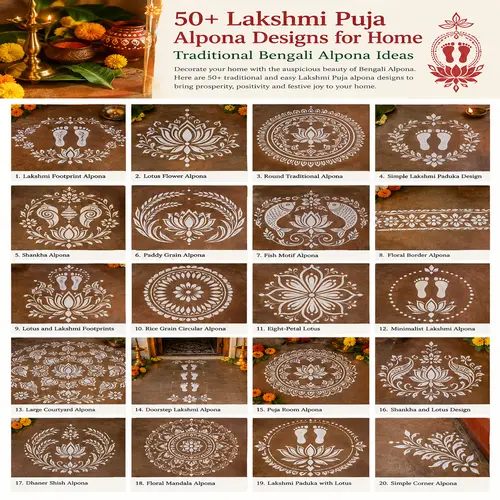
50+ Lakshmi Puja Alpona Designs for Home | Traditional Bengali Alpona Ideas
Lakshmi Puja is one of the most beautiful occasions in Bengali homes, and no traditional celebration feels complete without a graceful Alpona at the entrance or around the puja space. Lakshmi Puja Alpona Designs, made traditionally with rice paste, Bengali Alpona combines artistic patterns with symbols that represent prosperity, purity, fertility, and divine blessings.
If you are looking for Lakshmi Puja Alpona designs for home, this guide brings together more than 50 traditional and easy ideas. From Maa Lakshmi’s footprints and lotus flowers to shankha, paddy and floral patterns, these designs can help you create a welcoming puja space while keeping Bengali traditions alive.
What Is Bengali Alpona?
Alpona, also written as Alpana, is a traditional Bengali folk art created using rice paste. Traditionally, women in Bengal draw Alpona on floors, courtyards, entrances and puja areas during festivals and auspicious occasions.
For Lakshmi Puja, Alpona has a special place because many designs incorporate symbols associated with Maa Lakshmi, including lotus flowers, Lakshmi’s footprints, paddy grains, conch shells and other auspicious motifs.
Today, you can create both elaborate traditional patterns and simple Alpona designs depending on your available space and artistic experience.
50+ Lakshmi Puja Alpona Design Ideas
1. Lakshmi Footprint Alpona
One of the most popular designs features a pair of small footprints leading from the entrance toward the puja room. Traditionally, these footprints represent Maa Lakshmi entering the home.
2. Lotus Flower Alpona
The lotus is closely associated with Maa Lakshmi. A large lotus surrounded by decorative curves makes a beautiful centerpiece for the puja area.
3. Round Traditional Alpona
Create a circular pattern using concentric borders, flowers, dots and traditional Bengali motifs. This design works particularly well in front of a Lakshmi Puja altar.
4. Simple Lakshmi Paduka Design
For beginners, draw two symmetrical footprints and surround them with small flowers, dots and curved lines.
5. Shankha Alpona
The conch shell, or shankha, is an important auspicious symbol in Bengali households. Add one or more shankha motifs to a traditional circular Alpona.
6. Paddy Grain Alpona
Paddy represents abundance and prosperity. Use curved grain patterns around a central lotus or Lakshmi footprint design.
7. Fish Motif Alpona
Traditional Bengali Alpona often incorporates fish motifs. A pair of decorative fish can add a distinctly Bengali character to your Lakshmi Puja decoration.
8. Floral Border Alpona
Create a simple floral border around the puja space or entrance. It is easy to draw and works well even in smaller homes.
9. Lotus and Lakshmi Footprints
Combine a central lotus with Lakshmi’s footprints approaching it from the entrance. This creates a meaningful and attractive design.
10. Rice Grain Circular Alpona
Use small rice-grain shapes to form a circular pattern around the central design.
11. Eight-Petal Lotus
An eight-petal lotus makes an elegant centerpiece and can be surrounded by dots, leaves and curved decorative lines.
12. Minimalist Lakshmi Alpona
If you prefer a clean appearance, use only Lakshmi footprints, a few lotus petals and small decorative dots.
13. Large Courtyard Alpona
A spacious courtyard gives you the opportunity to create a large symmetrical composition combining lotus, flowers, leaves, fish and footprints.
14. Doorstep Lakshmi Alpona
Draw a compact design immediately outside the main entrance. Lakshmi footprints can lead from the doorway toward the inside of the house.
15. Puja Room Alpona
A circular design around the puja seat creates a beautiful traditional backdrop without requiring a large floor area.
16. Shankha and Lotus Design
Combine two traditional symbols—shankha and lotus—with curved borders and floral details.
17. Dhaner Shish Alpona
Draw stylized paddy stalks around the outer edge of your design to represent prosperity and abundance.
18. Floral Mandala Alpona
A mandala-inspired circular design can combine multiple layers of petals, leaves and dots.
19. Lakshmi Paduka with Lotus
Place the footprints inside or above a large lotus motif for a classic Lakshmi Puja arrangement.
20. Simple Corner Alpona
Small corner designs are ideal for apartments where floor space is limited.
21. Traditional Bengali Motif Alpona
Combine familiar Bengali folk motifs with floral patterns to create a distinctly regional design.
22. Five-Petal Flower Alpona
Five-petal flowers arranged symmetrically can create an attractive beginner-friendly pattern.
23. Conch and Paddy Design
Combine shankha motifs with paddy stalks for an auspicious Bengali-inspired composition.
24. Circular Footprint Alpona
Place Lakshmi footprints in the center and surround them with several decorative circular borders.
25. Lotus Border Alpona
Create repeated lotus petals around the outer border of your design.
26. Small Apartment Alpona
Use a small lotus, two footprints and a simple dotted border for a beautiful design that requires very little space.
27. Lakshmi Puja Entrance Alpona
Create a welcoming entrance with footprints pointing toward the home and floral patterns around the doorway.
28. Peacock-Inspired Alpona
Decorative peacock shapes can be incorporated into a larger traditional Bengali composition.
29. Leaf Pattern Alpona
Use curved leaves and vines to create an elegant natural border.
30. Geometric Bengali Alpona
Combine circles, triangles, dots and curved lines with traditional motifs for a contemporary interpretation of Bengali Alpona.
31. Large Lotus Mandala
A large lotus with multiple layers of petals can become the focal point of your puja decoration.
32. Lakshmi Footprints with Dots
For beginners, footprints surrounded by evenly spaced dots are simple yet attractive.
33. Fish and Lotus Alpona
Combine two traditional motifs in a symmetrical design suitable for the entrance or courtyard.
34. Paddy and Lotus Combination
Place a lotus in the center and surround it with curved paddy stalks.
35. Floral Vine Alpona
Create flowing vines around the central design using leaves and small flowers.
36. Traditional Border Pattern
A repeating pattern of flowers, dots and curved lines works beautifully around the perimeter of a puja area.
37. Lakshmi Paduka Entrance Trail
Create several pairs of small footprints leading from the entrance toward the puja room.
38. Shankha Circle Alpona
Arrange several small conch motifs around a central lotus or flower.
39. Bengali Folk Art Alpona
Use bold traditional motifs and flowing lines inspired by Bengal’s folk-art traditions.
40. White Rice-Paste Alpona
The classic white-on-floor appearance remains one of the most timeless choices for Lakshmi Puja.
41. Small Lotus Alpona
A simple five- or eight-petal lotus works well beside a Lakshmi idol or image.
42. Lakshmi Footprint Border
Instead of placing footprints in the center, use small footprints as a decorative border.
43. Floral Circle Alpona
Arrange flowers and leaves in a symmetrical circular formation.
44. Paddy Circle
Use repeated rice-grain or paddy motifs to create a circular frame around the main design.
45. Shankha-Lotus-Paddy Alpona
Combine three traditional motifs into one balanced composition.
46. Simple Navapatrika-Inspired Pattern
Use leaves and natural forms to create a festive design inspired by Bengali puja traditions.
47. Decorative Lakshmi Alpona
Combine footprints, lotus petals, flowers and ornamental borders for a more elaborate design.
48. Modern Bengali Alpona
Keep the traditional white rice-paste appearance but use cleaner geometric shapes and simplified motifs.
49. Kids-Friendly Alpona
Choose simple flowers, dots, leaves and footprints that children can help draw as part of the family celebration.
50. Grand Lakshmi Puja Alpona
For a larger space, combine a central lotus, Lakshmi footprints, paddy stalks, shankha, fish, flowers and multiple decorative borders.
51. Minimal Lotus and Footprint Design
A lotus at the center with two pairs of Lakshmi footprints creates a beautiful design without excessive detail.
52. Traditional Courtyard Mandala
Use multiple circular layers containing petals, leaves, dots and Bengali folk motifs for a grand courtyard decoration.
53. Lakshmi Puja Chowk Alpona
Create a square or rectangular traditional floor design around the puja area, using a central floral motif.
54. Door-to-Altar Footprint Design
Draw Lakshmi’s footprints beginning near the entrance and gradually leading toward the puja altar.
55. Simple Bengali Alpana for Beginners
Start with circles, dots, petals, leaves and footprints. These basic shapes can be combined into an attractive traditional composition.
How to Make Traditional Alpona for Lakshmi Puja
Traditional Alpona is generally made with rice paste. Soak rice in water, grind it into a smooth paste and dilute it slightly to achieve a consistency that is easy to apply.
Traditionally, the paste is applied using the fingers or a small cloth. Today, beginners can also use a thin brush or cotton bud for greater control.
Before drawing, clean the floor properly and allow it to dry. Sketching the main shape lightly can help beginners maintain symmetry.
What Do Lakshmi Footprints Mean in Alpona?
Lakshmi footprints are among the most recognizable motifs used during Bengali Lakshmi Puja. They are traditionally drawn with the feet facing into the home, symbolically representing the arrival of Maa Lakshmi and the blessings of prosperity.
This is why many Bengali families place Lakshmi Paduka Alpona near the entrance during Lakshmi Puja.
Best Places to Draw Lakshmi Puja Alpona
You can create Alpona in several areas of your home:
- Main entrance
- Puja room
- In front of the Lakshmi idol
- Courtyard
- Balcony
- Around the puja altar
- Doorstep
- Living-room puja space
Choose the design according to the available floor area. A small apartment can look equally festive with a simple lotus and footprint design.
Tips for Drawing Beautiful Alpona
First, clean the floor thoroughly. A clean surface helps the rice paste appear brighter.
Next, begin with the central motif and gradually work toward the outer border. Symmetry becomes easier when you build the design from the center.
Keep the rice paste smooth but not excessively watery. Practice simple circles, petals and curves before attempting an elaborate pattern.
Finally, remember that Alpona is a traditional form of festive expression. It does not need to look perfectly symmetrical to be beautiful.
Traditional Lakshmi Puja Decorations to Pair With Alpona
Alpona looks especially beautiful when combined with other traditional Bengali decorations. You can use flowers, diyas, banana leaves, kalash, mango leaves, incense, traditional puja utensils and other auspicious decorations around the puja area.
A beautiful Alpona does not need expensive decoration. Traditional elements, thoughtful placement and a clean puja space can create a warm festive atmosphere.
Lakshmi Puja Alpona: Tradition Meets Creativity
From a simple pair of Lakshmi footprints to an elaborate lotus mandala, there are countless ways to create Alpona for Lakshmi Puja. Traditional Bengali symbols such as lotus, paddy, shankha, fish and Lakshmi Paduka allow you to preserve cultural traditions while adding your own artistic touch.
Whether you live in Bengal or far away from home, drawing Alpona can be a wonderful way to bring a little piece of Bengali tradition into your Lakshmi Puja celebration.
For Bengali puja books, traditional puja essentials, religious products and other Bengali cultural items, explore Bongo Hridoy, your online destination for traditional Bengali products.
Frequently Asked Questions
What is the best Alpona design for Lakshmi Puja?
Lakshmi footprints, lotus flowers, paddy motifs and circular floral patterns are popular choices. Beginners can start with a simple lotus and Lakshmi Paduka design.
What is used to make traditional Bengali Alpona?
Traditional Alpona is generally made using rice paste. Rice is soaked, ground and mixed with water to create the white paste used for drawing.
Which direction should Lakshmi footprints face?
In Bengali Lakshmi Puja traditions, Lakshmi footprints are commonly drawn facing inward toward the home, symbolizing Maa Lakshmi entering the household.
Can beginners draw Lakshmi Puja Alpona?
Yes. Start with simple motifs such as circles, dots, flowers, lotus petals and footprints. With practice, you can gradually create more detailed designs.
Can I make Alpona in a small apartment?
Absolutely. A small entrance, balcony or puja-room space can accommodate a compact lotus, footprint or floral Alpona.
Is Alpona only used during Lakshmi Puja?
No. Bengali Alpona is used during various festivals, weddings, pujas and other auspicious occasions. Different designs and motifs may be chosen according to the occasion.